It has been called “arguably the best-known verses ever written by an American.”
It has been reproduced and re-imagined in countless newspapers, magazines, films, radio and television shows. Its popularity and influence are undeniable. And its iconic
opening line is instantly recognizable to virtually everyone in the English-speaking world – “T’was the night before Christmas…”
Despite its fame, the poem’s author – Clement Clarke Moore – is hardly a
household name. Born in New York City on July 15, 1779 – in the middle of the
Revolutionary War – Moore was the only child of Bishop Benjamin Moore and Charity
Clarke Moore.

Clement’s maternal grandfather – Major Thomas Clarke – owned a large
Manhattan estate in the days before the city overwhelmed the island. Clement would
later inherit the estate, which his grandfather had named “Chelsea.” Today, Manhattan’s large West Side neighborhood still bears that name.
In 1798, Clement graduated first in his class from Columbia. After earning a
master’s degree from Columbia, Moore taught Oriental and Greek Literature, and
eventually became a professor of Divinity and Biblical Learning at the General
Theological Seminary of the Protestant Episcopal Church.
In 1813, when Clement was 34, he married 19-year-old Catharine Elizabeth
Taylor. It was, apparently, a happy marriage – they had 9 children – but not a long one.
Sadly, Catharine died in 1830; Clement never remarried.
Throughout his career, Moore published many scholarly works, including a two
volume Hebrew dictionary. He wrote poetry, including the poem that gave him
lasting fame.
The legend concerning the poem’s origins goes something like this: On Christmas
Eve of 1822, during a sleigh-ride home from a shopping trip into town, Moore was
inspired by the sleigh bells to write a poem for his children. He decided to make the
story about a visit from St. Nicholas. It’s said that he modeled his version of St. Nick on
the old Dutchman who did odd jobs around Chelsea.
When he read the poem to his children after dinner that night, they were
spellbound. And there it might have ended – a happy little verse written by a loving
father for the delight of his children. Moore had no intention of publishing the poem.
But a visiting family member was as enthralled as the children, and took a copy
that she later gave to a friend from Troy, New York. The next year, the friend submitted
the poem to the editor of the Troy Sentinel.
The editor, recognizing a gem, printed it – anonymously – as “Account of a Visit
from St. Nicholas” on December 23, 1823. After that, the poem took off like Santa’s
reindeer clearing the treetops, and it never stopped.

It was so instantly popular, four other papers published it within a few weeks –
after Christmas. In succeeding years, the poem began appearing in newspapers and
magazines everywhere.
When Moore learned of the poem’s publication, it “caused him chagrin and
regret.” He had intended it for his family, and felt that the poem was a “mere trifle,”
beneath his dignity as a scholar.
Although various publishers began attributing the poem to Moore around 1837, he
didn’t acknowledge authorship for 22 years after he’d first read it to his family on
Christmas Eve. In 1844, he finally claimed it when he included the poem in a collection
of his poetry at the insistence of his then-grown children.
Regardless of Moore’s critical view, his little poem had an impact on our culture
that went well beyond some rhyming words in a newspaper. It wasn’t just instantly
popular; it changed the way that people celebrated Christmas.
Historian Stephen Nissenbaum says that “A Visit from St. Nicholas” appeared at
a time “when the focus of Christmas was moving from adult revelry to domestic
contentment.” Moore’s poem “reinforced this movement.” It played a formative role in
shaping the modern American Christmas, and helped recast St. Nicholas as a jovial elf
and turned Christmas into a time for giving gifts to children.
The earliest stories about St. Nicholas depicted him as a rather stern fellow, who
arrived – typically on Christmas Day – with gifts, but also to dispense punishment to
naughty children. The old St. Nick was skinny, wore a bishop’s miter and robes, and
only had one, unnamed reindeer to pull his sleigh.
Moore, in a single – unplanned – stroke, created a new model for Christmas. He
gave Santa eight flying reindeer and gave them all names. Moore’s Santa bounds down
the chimney on Christmas Eve – not Christmas Day – carrying a sack filled with toys,
“dressed all in fur, from his head to his foot,” his beard “white as the snow.” And “he
had a broad face and a little round belly/ That shook when he laughed, like a bowlful of
jelly.”
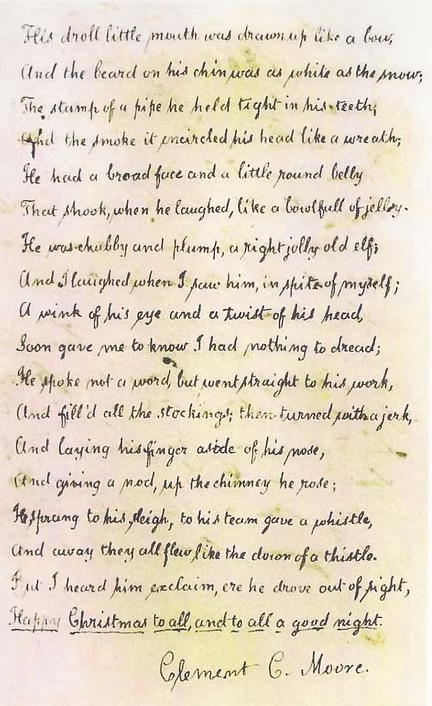
Late in life, Moore produced four handwritten copies of the poem. Despite what
he believed about his “little trifle,” the copies are among the most valuable documents in American history. In 1997, one of them sold at auction for $211,000.
Through the years the poem has been parodied in pop culture in a multitude of
ways. One of my favorites came from a classic 1968 Peanuts comic strip. Sally Brown –
Charlie Brown’s little sister who never quite knew what was going on – attempted to
recite the poem from memory. She hadn’t gotten very far when she said, “The stockings
were hung by the chimney with care, in hopes that Jack Nicklaus soon would be there.”
On July 10, 1863 – in the middle of the Civil War – Clement Moore died at
Newport, Rhode Island. He was just days away from his 84th birthday. He was
eventually buried at Trinity Cemetery, in New York City. Each December people gather
at the chapel to read “A Visit from St. Nicholas” and march in a lantern-lit procession to
lay a wreath at his grave.

The little poem with such humble beginnings indeed occupies a lofty perch. And
it ends with the unforgettable line: “But I heard him exclaim, ere he drove out of sight/
‘Happy Christmas to all, and to all a good-night.’”